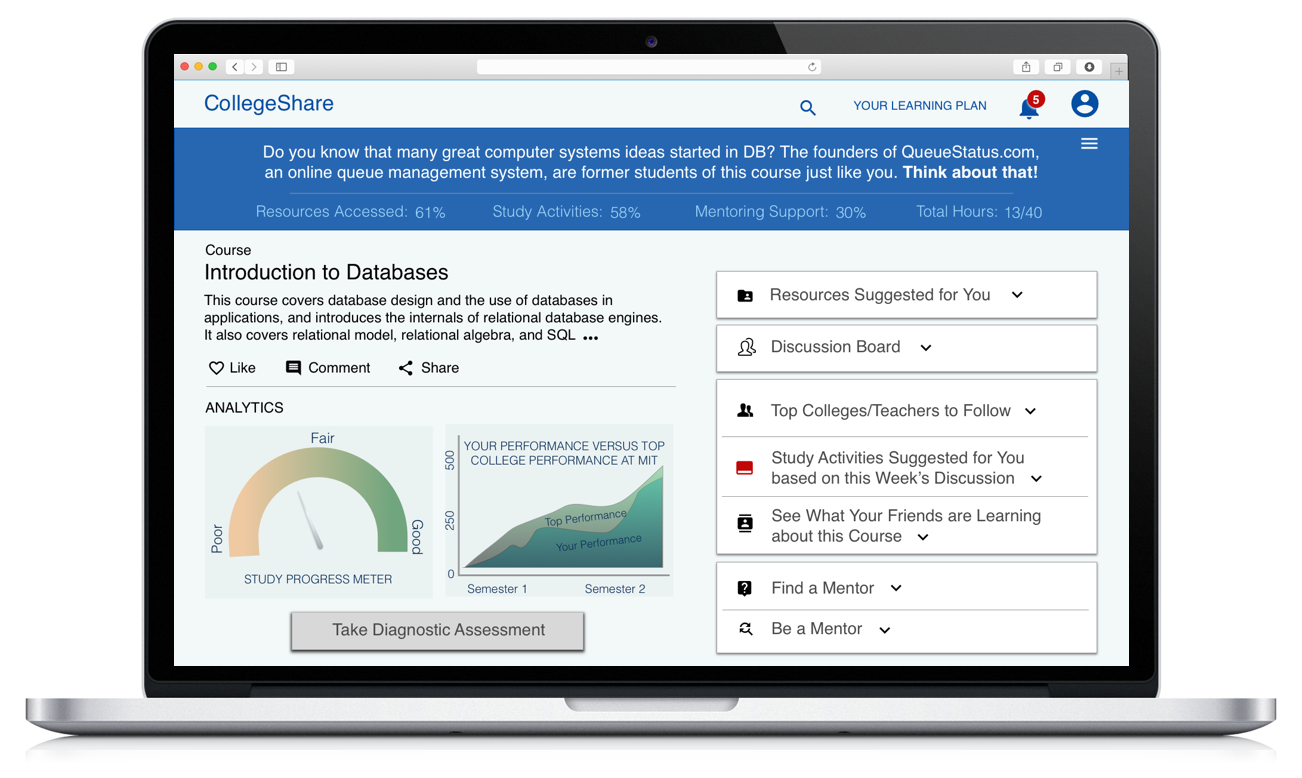
CollegeShare
With massive availability of online learning resources on the Internet, we needed to design great experiences to support the shift towards social and personalized learning at scale, which we believe will transform the education industry for all.
CollegeShare is a social learning service that allows students and teachers across different colleges to share and discuss their learning, teaching, and college experiences around specific courses, while leveraging the power of analytics to achieve differentiated skills development, enhance collaborative learning, and inspire students to self-drive their learning experiences.
I worked as an independent UX researcher on this project. The design was done in Sketch, with click-through interactive support in Principle.

Context-Aware e-Collaborative Environments for e-Health Decision Support
This project involves field observation, interviews, diary study, and questionnaire survey of clinical practitioners across three geographical regions - the UK, the UAE, and Nigeria - in order to draw insights to inform the design of e-health systems for supporting collaborative clinical decision making among clinicians working independently across organizational and geographical boundaries.
I was the project UX research lead. I also designed and programmed the main solution architecture for the key project deliverable (the Context-Aware Decision support for e-HEALTH, CaDHEALTH system). I also conducted the system usability testing, which incorporated a novel approach for evaluating the potential viability of a clinical practice behavior (or workaround) that may not adhere strictly to guidelines, but might be of potential benefit to a given clinical case or work context, before applying the workaround in decision making
The project resulted in a set of design guidelines for the development of enterprise information systems for e-health decision support and insights for informing global e-health strategies.
The project produced eight publications, including two journal papers in the IEEE Trans Inf Technol Biomed and Elsevier's Telematics and Informatics

|
 |

Understanding the Practice of Discovery in Enterprise Big Data Science
This project combined rapid ethnography and contextual inquiry to understand and possibly predict how new data practices, organizational dynamics, and social infrastructures of existing platforms for big data science, shape innovation and scientific discovery in the era of big data.
The goal of the project was to help my product team to understand and pay attention to the overarching goals, values, and practices that drive the functioning of recommendation algorithms. For example, it is one thing for a machine learning expert or data scientist to say that their system is able to connect the dots and draw insights from data in order to determine that candidate X is not qualified for a loan, but it is a different thing to ask what belief (or value) systems govern the algorithm’s reasoning process? Toward what goal was the algorithm acting? Who generates the data? From where? Under what contexts? How do these ultimately affect the final outcome of the analytics process?
I was the UX research lead. My team was tasked with helping the product team understand the behaviors and work practices of data scientists and what collaborative experience is like for people involved in enterprise big data science, and to evaluate the team's design decisions.
The project identified new metrics for understanding collaborative discovery from data, and led to new insights for informing the design of tools, abstractions, and visualizations to facilitate collaborative discovery in big data science. The project also resulted in a paper presented at AHFE2015

Mobile Analytics
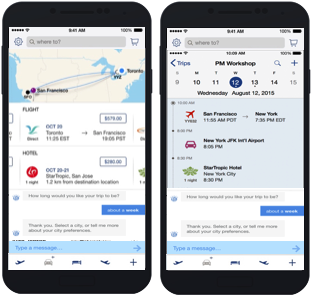
Yes, you have now moved your business to the mobile platform. Your customers can access your services on the move via apps. Congratulations! But seriously, what's next?
To help you answer this question effectively is precisely what the goal of this project is. We worked with business clients to understand their business goals and create great experiences for their users on the mobile platform. We conducted user-centered study of the customers' behavior while using your mobile apps. Do they use the app as intended by your designers? Do they struggle with using the app? Where? Why? How does it affect your conversion rate?
We analyzed large-scale data about app user behaviors (screen navigation patterns, gestures, session time, screen views, etc.) — collected using mobile analytics iOS and Android SDK tools — and conducted usability tests to improve our design decisions.
This project is still on-going. Preliminary result includes a patent disclosure, as well as successful initial user testing with clients.

|
 |

The Work Exchange
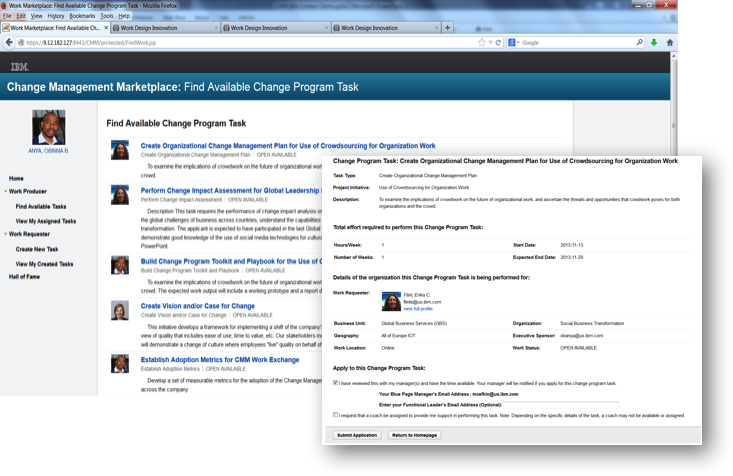
With the move towards open work models, we needed to understand the collaborative behaviors and motivations of employees in their workplaces to inform the design of a crowdsourcing support for them. This project focused on prototyping such workspace for data science.
Imagine -- for example, as a data scientist or manager -- the possibility of tapping into a virtual work exchange throughout your enterprise, or even across enterprise boundaries with people around the world who have unique skills in order to draw talents as and when needed to get your work, thereby beating the limitations of existing traditional staffing models. This project, the Work Exchange, is a social business platform that allows you to achieve this vision. The system enables fast and scalable design of work requests by componentizing units of tasks as service requests, and employs market-based matching mechanisms, social identity for expertise recognition, social reputation management, and reward.
I led the UX research, which involved Contextual Interviews, Surveys, and the RITE method. The prototype was created using HTML5, the Dojo framework as well as Sketch.
From a research point of view, the project explored a deeper understanding of human experience at work, and involved in-depth analyses of organizational work practices. It involves user-centered research, service system modeling, and concept development.
The Work Exchange was deployed for pilot use at IBM's Global Organizational Change Management Unit with hugely successful results.
The project resulted in a conference paper at HCOMP2013, two ACM workshops at CSCW2014 and GROUP2014, and a pending patent disclosure.

|
 |
